

G-Cup Minimizer Bra: Why Your Usual Size May Not Fit
You know your bra size. So why does one minimizer say 75G, another say 80EF/75G, and a third simply offer XL?
A clear, practical G-cup fitting guide for Singapore and Malaysia—because the right label is only the start of a comfortable fit.

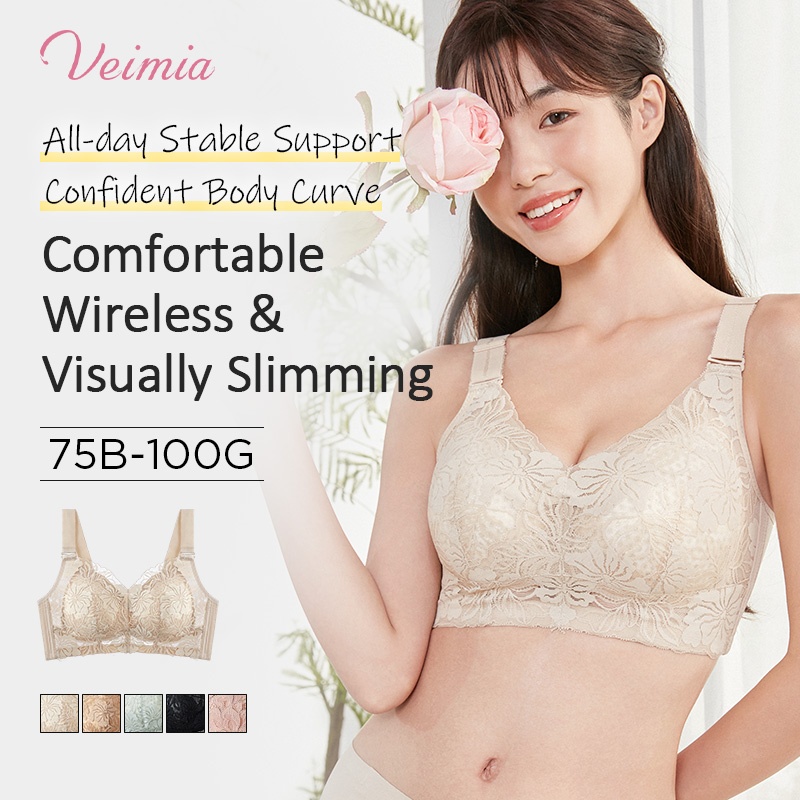
These are different product styles, not a same-person before-and-after test. Photos help you inspect shape and coverage; they do not determine size.
Three labels. Three different questions.
Picture this: you're shopping after work, and your favourite bra says G75. You open two minimizer pages. One has a neat 75G/34G option; another shows 80EF/75G. A third product offers only M, L and XL. It's tempting to assume that all three can be converted using one rule.
They can't. Cup letters and bands change between regional size conventions, while an M–XL range may combine several band and cup measurements into a single size. Even within the same brand, fabric stretch and cup construction can alter the result.
Familiar Japanese or cm-based label. It is a useful starting point, not a guarantee across styles.
A size choice on a specific VEIMIA listing. Read it exactly as that product names it; don't generalise it.
Requires the individual item's chart. Never assume every G75 wearer should buy XL.
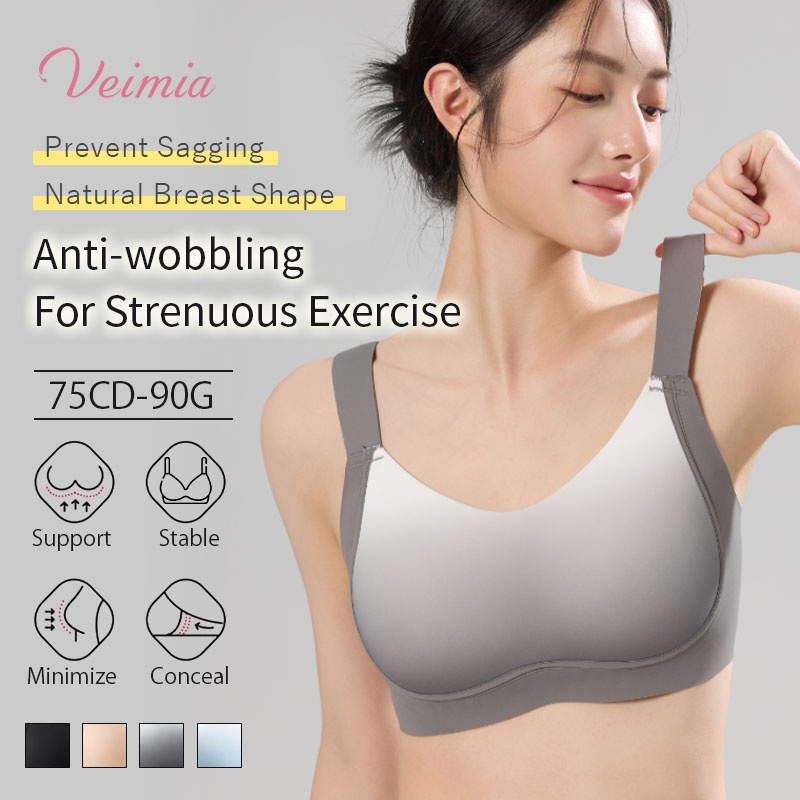
The VEIMIA Lace Minimizer lists 75G/34G. The VEIMIA Anti-wobbling Minimizer includes a combined 80EF/75G option. Those are actual labels on two different products, not a claim that one size fits exactly like the other.
You may also see inch-based sizes such as 34G, or UK sizes with GG cups. The cup-letter sequence is not identical across all systems. Treat an online conversion chart as a clue and the actual product size chart as your next check—not as an instruction to order.
Measure first. Decide on the label second.
If the bra you've worn for years has stretched, your old size may no longer describe the fit you need. A soft measuring tape and a couple of minutes can save more guesswork than reading a dozen reviews.
Underbust
Stand upright. Measure horizontally around your ribcage just beneath your bust. Keep the tape snug, level and comfortable. This helps you evaluate the band category.
Full bust / overbust
Follow the brand's method. VEIMIA's size guide suggests leaning forwards about 45° and measuring around the fullest part of the bust. Repeat your reading for consistency.
The line drawings are simplified measurement-position illustrations, not anatomical photographs or a substitute for the official fitting instructions.
Use centimetres consistently
Record both numbers in cm. Don't mix a 75-band label with measurements taken in inches without checking the retailer's chart.
Open the exact product page
Check the chart for the colour and style you want. A previous VEIMIA purchase doesn't guarantee a second model uses the same size.
Read the entire size option
For a grouped label such as 80EF/75G, don't select it by spotting “75G” alone. Match your measurements to that style's guide.
Check cup shape too
The right band cannot fix a cup that is too shallow or cuts into the bust. Full coverage, stretch and side-panel height matter.
VEIMIA also provides an online bra measurement guide . Its own FAQ recommends checking the individual product's fit notes when measurements sit between sizes. That advice matters more than a one-size-fits-all G-to-XL conversion.
For G cups, check where the fabric goes.
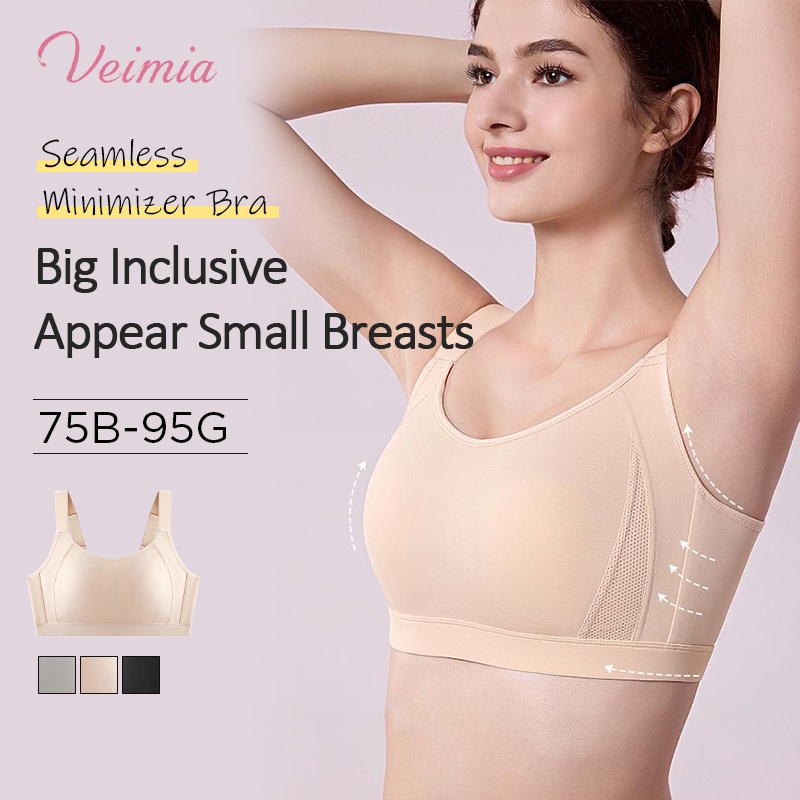
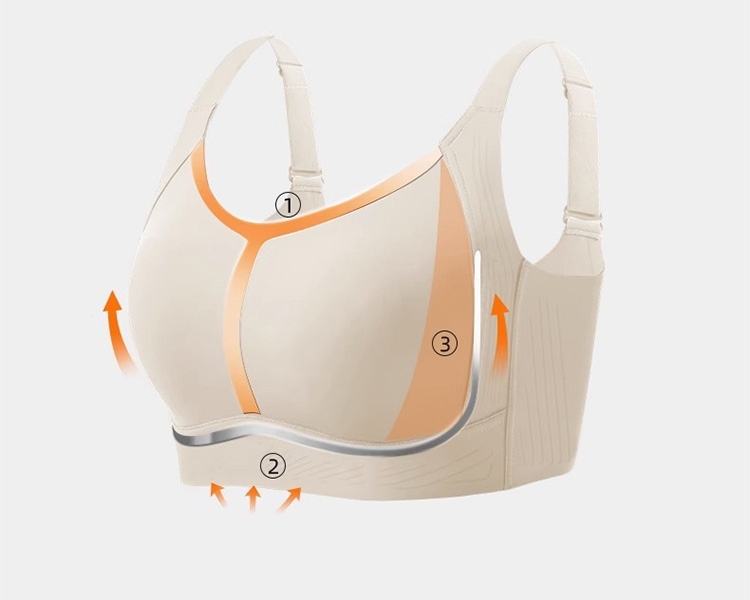
Two people can both wear G75 and still need different cup shapes. One may want more room near the upper edge; another may need a wider cup base or higher side wings.
That is why a cup that feels “too small” isn't always solved by jumping straight to the next letter.
Start at the neckline: does tissue spill over, or does the fabric lie smoothly? Then look under the arms. High side panels can offer more coverage, but they shouldn't jab into your armpit or fold when you move.
Finally, check the cup's forward depth. A minimizer aims for a smoother outline under clothing; it should not force breast tissue into painful compression.
A brand's shaping demonstration can explain design intent. It cannot prove that a particular G-cup shopper will look or feel the same in that bra.
Try it on. Then forget the number for a moment.
Once the bra is on, do a simple check in a mirror. Use the same test whether your tag says G75, 75G or something entirely different.
Band
Sits level and secure. It shouldn't ride up when you lift your arms.
Cups
No obvious overflow, deep gaps or creasing at the edge.
Sides
Coverage feels contained without digging into the underarm.
Straps
Stay on the shoulders without carrying all the tension.
Movement
Sit, reach up and breathe. You should not need to keep adjusting it.
A steady band matters. If it rides up, the band may be too loose. If the cup spills while the band feels secure, the problem may be cup capacity or shape. If straps dig in, check the band and cups before simply loosening or tightening the straps.
For further visual fitting cues, see the Wacoal five-point fitting guide . The principles are useful even when comparing a wire-free minimizer.
Don't just size up. Find out what's wrong.
Online charts sometimes put measurements near the edge of two options. Instead of automatically choosing the larger number, look at the symptom you want to fix.
Band feels wrong?
If the band is too tight even on its loosest setting—or rides up when fastened—recheck your underbust and the next band options. Changing band size may require a cup adjustment too; use that brand's size chart.
Band fits, cup doesn't?
If the neckline cuts in or the cup has empty space, compare cup capacity and shape without immediately changing the band. A different style may fit better than one larger or smaller letter.
Think of your bra size as a starting address. The size chart gets you to the building; the actual fit tells you whether you're in the right room.
And if the product has four rows of hooks, those rows are adjustment positions—not four different cup sizes. They're useful for fine-tuning the band, but cannot create extra cup depth.
Let the outfit be the final test.
In Singapore or Malaysia, a G-cup bra may need to work under a thin T-shirt on the train, a work blouse in an air-conditioned office, and a light knit over dinner. Comfort in the fitting room is only part of the story.
Take two front-and-side photos wearing the same top. Compare whether the cup edge shows, whether the blouse pulls across the chest and whether the band stays level. Don't mistake a different angle or posture for evidence of a smaller cup size.
For a slim-cut white tee, a smoother cup finish may matter most. For a button-down, complete cup containment and stable band tension can make the outfit easier to wear.
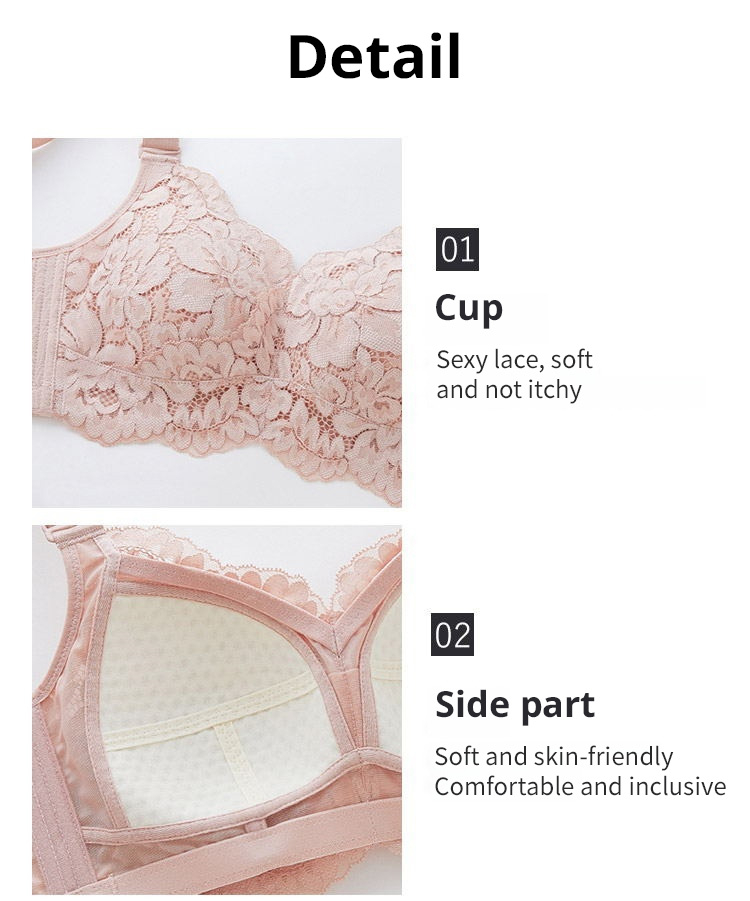
A lace minimizer can feel elegant and supportive, yet its texture may show through very fine fabric. A seamless design may disappear more easily under a top, provided its cup shape suits you.
Choose the silhouette you like without accepting a painful fit as the price of looking streamlined.
Two genuine size options to compare
These products illustrate why reading the exact dropdown matters. Both have G-cup-labelled options on the SG website, but their sizing formats and construction differ. Neither is a guaranteed match without measuring.
VEIMIA Anti-wobbling Minimizer Bra
Wireless, lightweight seamless cups with gel-strip support, adjustable straps and a 4-by-4 hook closure.
Size clue: the product lists 80EF/75G among its options. Use its own chart to check how that selection relates to your measurements.
S$39 at time of checking
Check Sizes & Shop
VEIMIA Full-Coverage Lace Minimizer Bra
Wireless lace cups with wider straps and higher sides for a fuller-coverage feel. Check whether lace texture suits your favourite tops.
Size clue: the listing includes 75G/34G and other separately labelled band/cup combinations. Country cup systems still require care.
S$39 at time of checking
Check Sizes & ShopPrices, size availability and offers can change. A size appearing in the selector does not guarantee that colour or size is currently in stock. Please check the live PDP before purchase. Browse all minimizer bras .
G-cup minimizer bra FAQs
Is G75 the same as XL in a minimizer bra?
No. G75 is a band-and-cup size label; XL is a product-specific letter size. Look up your bust and underbust measurements in the exact product chart rather than treating them as a fixed conversion.
What does 80EF/75G mean on a VEIMIA listing?
It's a grouped size option used on one VEIMIA product page. The label alone does not tell you that every 75G wearer will find it comfortable. Verify that product's fit chart and cup construction.
Do all G-cup minimizer bras fit the same?
No. Cup depth, band tension, fabric stretch and side coverage vary by design and brand, even when a label looks similar.
Can a minimizer change my actual bra cup size?
A minimizer can change the appearance and distribution of the bust under clothing. It does not reduce breast tissue or change your measurements. Choose the bra size by fit, not the “smaller-looking” claim.
What if my G-cup bra spills at the top but the band is comfortable?
Check cup capacity and shape before changing band size. A deeper or different-shaped cup may be more useful than a tighter band.
Should a new bra start on the loosest hook?
For a typical adjustable back-closure bra, the loosest comfortable hook is a common starting point so you can tighten it as the band ages. Follow the individual brand's instructions and make sure the band still stays level.
What is the best minimizer bra for G cups in Singapore?
There's no universal winner. The best one is available in a size range that actually matches your measurements, contains your bust without spilling, has a secure band and remains comfortable through movement and warm-weather wear.
Editorial sources: VEIMIA SG product pages and size guide; VEIMIA FAQ; Wacoal's five-point fit guide. All model and bra photographs in this article are official VEIMIA promotional materials. Photos showing other product designs are labelled as construction examples, not proof that a featured product will fit a particular G-cup wearer. Seasonal sale and price details are current only at time of editorial review (20 November 2026).